Gathered from http://www.itmonline.org/arts/cupping.htm
This article was written by Subhuti Dharmananda, Ph.D., Director, Institute for Traditional Medicine, Portland, Oregon
Cupping refers to Chinese practice with thousands years in which a cup is applied to the skin and the pressure in the cup is reduced (by using change in heat or by suctioning out air), so that the skin and superficial muscle layer is drawn into and held in the cup. In some cases, the cup may be moved while the suction of skin is active, causing a regional pulling of the skin and muscle (the technique is called gliding cupping).
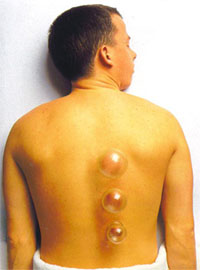 This treatment has some relation to certain massage techniques, such as the rapid skin pinching along the back that is an important aspect of tuina (12). In that practice, the skin is pinched, sometimes at specific points (e.g., bladder meridian points), until a redness is generated. Cupping is applied by acupuncturists to certain acupuncture points, as well as to regions of the body that are affected by pain (where the pain is deeper than the tissues to be pulled). When the cups are moved along the surface of the skin, the treatment is somewhat like guasha (literally, sand scraping), a folk remedy of southeast Asia which is often carried out by scraping the skin with a coin or other object with the intention of breaking up stagnation. Movement of the cups is a gentler technique than guasha, as a lubricant allows the cup to slide without causing as much of the subcutaneous bruising that is an objective of guasha. Still, a certain amount of bruising is expected both from fixed position cupping (especially at the site of the cup rim) and with movement of the cups.
Under the pain, or chronic inflammation/injury, or stiffness of muscle and other condition, there are local(such as at reacting points) or some area microcirculation stagnant, so the cupping (or Guasha) will cause bruise (purple mark) very easily, which is an indicator and treatment with no pain. But the cupping at normal area would not cause such a bruise or just very light mark. After a few sessions’ cupping, the mark will be lighter and lighter at each time. Cupping is a gentle stimulation to the meridian / nervous system, and it maybe activates the circulation improvement at the microcirculation level though “teaching” the system itself relieve the spasm of small arteries and veins which connect with capillaries (Dr. Arthur Yin Fan note).
Traditional cupping, with use of heated cups, also has some similarity to moxibustion therapy.Heating of the cups was the method used to obtain suction: the hot air in the cups has a low density and, as the cups cool with the opening sealed by the skin, the pressure within the cups declines, sucking the skin into it. In this case, the cups are hot and have a stimulating effect something like that of burning moxa wool.
In some cases, a small amount of blood letting (luoci; vein pricking) is done first, using a pricking needle, and then the cup is applied over the site. The pricking is usually done with a three-edged needle, applied to a vein, and it typically draws 3-4 drops of blood (sometimes the skin on either side is squeezed to aid release of blood). A standard thick -gauge acupuncture needle or plum blossom needle may be used instead. This technique is said to promote blood circulation, remove stasis, and alleviate swelling and pain. It is employed especially when there is a toxic heat syndrome and for a variety of acute ailments.
The following report is derived mainly from a survey of reported cupping techniques published in 1989 (1), supplemented by information from acupuncture text books (5-9).
Early History
The earliest use of cupping that is recorded is from the famous Taoist alchemist and herbalist, Ge Hong (281-341 A.D.). The method was described in his book A Handbook of Prescriptions for Emergencies, in which the cups were actually animal horns, used for draining pustules.As a result of using horns, cupping has been known as jiaofa, or the horn technique. In a Tang Dynasty book, Necessities of a Frontier Official, cupping was prescribed for the treatment of pulmonary tuberculosis (or a similar disorder). More recently, Zhao Xuemin, during the Qing Dynasty, wrote Supplement to Outline of Materia Medica, including an entire chapter on-fire
jar qi-(huoquan qi). In it, he emphasized the value of this treatment, using cups made of bamboo or pottery, in alleviating headache of wind -cold type, bi syndrome of wind origin, dizziness, and abdominal pain. The cups could be placed over acupuncture needles for these treatments.One of the traditional indications for cupping is dispelling cold in the channels. This indication is partly the result of applying hot cups. For example, bamboo cups would be boiled in an herbal decoction just prior to applying to the skin (this is one type of shuiguanfa, or liquid cupping, so -called because a liquid is incorporated into the treatment). Both liquid cupping and cupping over an acupuncture needle are favored for treatment of arthralgia. Cupping also is thought to dispel cold by virtue of its ability to release external pathogenic factors, including invasion of wind, damp, and cold.
Modern Cupping
During the 20th century, new glass cups were developed (see Figure 1). Common drinking glasses have been used for this purpose, but thick glass cupping devices have also been produced and are preferred. The introduction of glass cups helped greatly, since the pottery cups broke very easily and the bamboo cups would deteriorate with repeated heating. Glass cups were easier to make than the brass or iron cups that were sometimes used as sturdy substitutes for the others; further, one could see the skin within the cup and evaluate the degree of response.
The glass cups are depressurized by providing some fire in the cup to heat up the air within just prior to placement. For example, hold a cotton ball dipped in alcohol with a pincer, ignite it, hold it in the cup, then rapidly apply to the skin; this is called shanhuofa (flash -fire cupping; see Figure 2). Sometimes, a small amount alcohol is put in the cup and lit; this method is called dijiufa (alcohol -fire cupping).
At the end of the 20th century, another method of suction was developed in which a valve was constructed at the top of the jar and a small hand-operated pump is attached so that the practitioner could suction out air without relying on fire (thus avoiding some hazards and having greater control over the amount of suction). Both glass and plastic cups were developed, though the plastic ones are not very well suited to moving along the skin once in place, as the edges are not entirely smooth and the strength of the cups is limited. The modern name for cupping is baguanfa (suction cup therapy).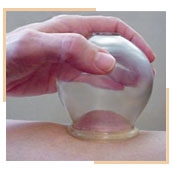
In order to allow easy movement of the glass cups along the skin, some oil is applied. Medicated massage oils (with extracts of herbs) are particularly useful for this purpose. Since the cups are applied at room temperature, the indication of removing cold from the channels is no longer as applicable, at least to stationary cups. There is some friction generated with moving cups, so that there is a small but significant amount of heat applied by that method, especially if a warming oil is used as lubricant.
Generally, the cup is left in place for about 10 minutes (typical range is 5 -15 minutes). The skin becomes reddened due to the congestion of blood flow. The cup is removed by pressing the skin along side it to allow some outside air to leak into it, thus equalizing the pressure and releasing it. Some bruising along the site of the rim of the cup is expected.
Today, cupping is mainly recommended for the treatment of pain, gastro-intestinal
disorders, lung diseases (especially chronic cough and asthma), and paralysis, though it can be used for other disorders as well. The areas of the body that are fleshy are preferred sites for cupping. Contraindications for cupping include: areas of skin that are inflamed; cases of high fever, convulsions or cramping, or easy bleeding (i.e., pathological level of low platelets); or the abdominal area or lower back during pregnancy. Movement of the cups is limited to fleshy areas: the movement should not cross bony ridges, such as the spine. Following are some of the recommended treatment sites for various disorders.
Respiratory Diseases
For chronic bronchitis and asthma, one can apply cupping at the following points: dingchuan, dazhui (GV-14), shenzhu (GV-12), geshu (BL-17), xinshu (BL-15), jueyinshu (BL-14), feishu (BL-13), fengmen (BL-12), dashu (BL-11), tiantu (CV-22), shanzhong (CV-17), huagai (CV-20), and zhongfu (LU-1). [see: Acupuncture treatment of asthma for more information about several of these treatment sites].
For pediatric bronchitis: blood letting followed by cupping at dazhui (GV-14).
For pediatric acute bronchitis: feishu (BL-13), shenchang (KI-25), lingxu (KI-24).
Digestive Diseases
For dysentery, early morning diarrhea, and acute and chronic gastritis, perform cupping in the following areas: around the navel; at the bladder meridian shu points; or these stomach meridian points: burong (ST-19), guanmen (ST-22), huaroumen (ST-24),
tianshu (ST-25).
Pediatric indigestion: dachangshu (BL-25).
Pain Syndromes
Shoulder blade: jianwaishu (SI-14) and tianzhong (SI-11).
Loins: shenshu (BL-23), qihaishu (BL-24), guanyuanshu (BL-26).
Head: taiyang and yintang for refractory headaches and migraines; dazhui (GV-14) and baihui (GV-20) for parietal and occipital headaches; for trigeminal neuralgia: qihu (ST-13), fengchi (GB-20), sizhukong (TB-23), jiache (ST-6); for toothache: dashu (BL-11), with acupuncture, massage, and cupping at yifeng (TB-17), jiache (ST-6), xiaguan (ST-7), and hegu (LI-4).
Soft tissue injury: treat local pressure pain points and area of swelling; use plum blossom needling followed by cupping; additionally or alternatively use points above or below the site of injury along the channels that pass through the injury.
Gynecological Disorders
Infertility and irregular menstruation: shenshu (BL-23) with movement of cup downward (treat with acupuncture first, then do cupping).
Leukorrhea: yaoyan (extra point under the 3rd lumbar vertebra) and around baliao (BL-31 through BL-34).
Uterine cramps: needle zusanli (ST-36) and guanyuan (CV-4) and do cupping at guanyuan (CV-4).
Miscellaneous
Common cold: dazhui (GV-14).
Insomnia: xinshu (BL-15), geshu (BL-17), shenshu (BL-23).
Facial paralysis: needling and cupping dazhui (GV-14), along with needling local facial points.
Recent Research
The following protocols were reported to provide good results in individual clinical research reports:
a. Head pain (2): headache, toothache, sore throat, redness and soreness of the eyes, treated with blood letting followed by cupping. Treatment is applied to dazhui (GV-14) and dingchuan.
b.Frozen shoulder (3): after acupuncture at jianyu (LI-15) and jianliao (TB-14) to get propagated qi reaction, use pricking of ashi points followed by cupping over the bleeding area for 10-15 minutes. Ten treatments is a course of therapy.
c. Acute trigeminal neuralgia treating with blood letting followed by cupping (4): treatment is applied to dazhui (GV-14) and feishu (BL-13).
d.Acne (10): treatment is to use bloodletting followed by cupping at feishu (BL-13) and geshu (BL-17) on one day, then xinshu (BL-15) and ganshu (BL-18) the next day, alternating treatments for a total of eight days.
e. Urticaria (11): perform cupping at shenque (CV-8) three times consecutively for ten minutes each time. This is done for three days, followed by one day rest, and another three days as needed.
f. Acute diseases (13): fever and headache due to infection, acute conjunctivitis, lumbar sprain; perform blood letting at dazhui (GV-14), and then cupping (which promotes further bleeding).
Treatment Summary
Cupping therapies often follow the point selection pattern that is used for standard acupuncture therapy, with somewhat greater emphasis on the use of back points (due to the ease of performing this technique there). In particular, most practitioners rely on using back shu points (bladder meridian) and dazhui (GV-14). Cupping is frequently applied after treatment by acupuncture, blood letting, or plum blossom treatment.
References
1. Cui Jin and Zhang Guangqi, A survey of thirty years-clinical application of cupping, Journal of Traditional Chinese Medicine 1989; 9(3): 151-154.
2. Wu Jiashu, Observation of analgesic effect of acupuncturing dazhui point, Journal of Traditional Chinese Medicine 1989; 9(4): 240-242.
3. Ju Huadong, 30 cases of frozen shoulder treated by needling and cupping, International Journal of Clinical Acupuncture 1998; 9(3): 327-328.
4. Zhang Zhilong, Observation on therapeutic effects of blood -letting puncture with cupping in acute trigeminal neuralgia, Journal of Traditional Chinese Medicine 1997; 17(4): 272-274.
5. Cheng Xinnong, Chinese Acupuncture and Moxibustion, 1987 Foreign Languages Press, Beijing.
6. State Administration of Traditional Chinese Medicine and Pharmacy, Advanced Textbook on Traditional Chinese Medicine and Pharmacology, volume IV, 1997 New World Press, Beijing.
7. O. Conner J and Bensky D (translators), Acupuncture: A Comprehensive Text, 1981 Eastland Press, Seattle, WA.
8. Zhang Ruifu, Wu Xiufen, and Nissi Wang (compilers), Illustrated Dictionary of Chinese Acupuncture, 1986, Sheep's Publications, Hong Kong.
9. Academy of Traditional Chinese Medicine, An Outline of Chinese Acupuncture, 1975 Foreign Languages Press, Beijing.
10. Chen Decheng, Jiang Nawei, and Cong Xin, 47 cases of acne treated by prick-bloodletting plus cupping, Journal of Traditional Chinese Medicine 1993; 13(3): 185-186.
11. Wang Huaiping, Treatment of urticaria with cupping, Journal of Traditional Chinese Medicine 1993; 13(2): 105.
12. Li Jiang, A miraculous spinal pinching therapy, Journal of Traditional Chinese Medicine 1996; 16(3): 228-229.
13. Yin Ying, Blood -letting at a single point for treatment of acute diseases, Journal of Traditional Chinese Medicine 1997; 17(3): 214-216.
March 1999
Figure 1: Three types of cups.
Figure 2: Flash-fire cupping.
"Cupping" Takes The Pain Away
http://www.cbsnews.com/stories/2004/07/12/earlyshow/health/main628788.shtml
New York, July 12, 2004
(This info was from CBS/The Early Show)
(CBS) Cupping is a form of alternative pain therapy that recently left some curious marks on actress and new mom Gwyneth Paltrow. The mystery behind the circular marks on Paltrows back is solved by Michael Gaeta, president of the Acupuncture Society of New York, who describes the therapy on The Early Show.
He demonstrates the cupping therapy on the back of one of his patients, who was lying on a treatment table.
There are two forms of cupping therapy, Gaeta tells co-anchor Harry Smith. Cupping
therapy is a treatment in which the practitioner creates suction in a cup. And then applies that cup to the body, which then draws the skin up around the cup, under the cup.
The traditional method uses fire. Gaeta holds a cotton ball and wets it with alcohol. Then ignites the soaked cotton ball and places it in the cup.
He says, "Fire cupping uses a flame to create suction in the cup. You will see a
flame in the cup and then, we will apply the cup to the body".
The skin gets sucked up and rises under the cup as blood rushes up.
Cupping brings fresh blood to the area, Gaeta says. So it tends to improve circulation. It also helps open up the chest and benefit the lungs and can even benefit menstrual problems and digestive problems, too. Most commonly, it's used for aches and pains of various types as well as respiratory problems, cough, wheezing, things like that.
"It feels a bit strange", the patient says. Definitely doesn't hurt. It just feels like someone's pulling at your skin.
Gaeta notes, Cupping therapy is usually used as part of acupuncture or body work treatment. It's been part of Chinese medicine for over 2,500 years. Originally, animal horn was the original cup. The horn method is the original thing. Later on brass, ceramic, bamboo cups were used.
It looks like something out of medieval alchemy, but Gaeta says, it is just an alternate method of treatment.
He adds, Fire cupping is the traditional, most effective method. Some practitioners choose to use the suction cup method, where you pump up the suction cup and that's
it. Same kind of thing just doesn't use flame.
There are very few conditions in which cupping should not be used, such as high fever, skin disease or tendency to bleed easily.
Each cupping session last about 10 to 15 minutes and it can be repeated, once the marks are cleared, until the problem is resolved, Gaeta says. To get a treatment, he says, seek a licensed acupuncturist.
Gua Sha
http://en.wikipedia.org/wiki/Gua_Sha
This info from Wikipedia, the free encyclopedia
Gua Sha, literally "to scrape for cholera", sometimes given the descriptive French name "tribo-effleurage" by English speakers,[1] is a very ancient technique of treatment that is still widely used by practitioners of Traditional Chinese Medicine(TCM). It is used even more widely as a "folk" technique, by Chinese, as a preventive or remedial treatment upon members of individual households.
Gua sha is reported almost exclusivley in Western literature as 'cao gio'; somewhat equivocally as 'not abuse, pseudo-abuse,or pseudo-battery'. This being a result of East Asian immigrant population's relocation to the West during and after the Vietnam war, and the Western medical community's mixed reaction to that population's use of their traditional medicine.
It is also widely used in Indonesia. It is a traditional Javanese technique, known as kerikan (lit., "scraping technique"),[2] and it is very widely used, as a form of "folk" medicine, upon members of individual households.
Gua sha was introduced to the West in formal acupuncture training by Dr. James Tin Yau So as part of the curriculum of the first licensed acupuncture school in the US (1976) (New England School of Acupuncture). The first textbook on Gua sha was published in 1995.
Contents below included in:
1 Gua Sha: the "folk" technique
2 The Gua Sha technique
3 Indications
4 Cross-cultural confusion with physical abuse
5 Notes
6 See also
7 References
Gua Sha: the "folk" technique
In describing the Gua Sha techniques as a form of "folk" medicine, the term "folk" is not being used in any pejorative sense. It is used to emphasize:
the extremely widespread domestic use of the technique (thus, used by the "folk") as a method of first-contact intervention,
that complex medical diagnosis is not required (and, thus, any decision to use or not use Gua Sha can be reliably made by the "folk"), and
the overall safety of the technique (meaning that it is safe for the "folk" to use).
Notwithstanding this, the Gua Sha technique is just as important a part of the legitimate practice of the specialist practitioners of Traditional Chinese Medicine as is the use of fire cupping; and it is a highly reputable technique that is applied just as much by these highly trained experts as it is applied by the "folk" users.
As with many of the "folk" methods that are used domestically as a form of first intervention, the use of Gua Sha often precludes any need for any more complex medical treatment; and, because its use means that further medical treatment is unnecessary, the technique, although extremely widespread, is often hidden from view, and its role as a very significant and very important participant in the overall health care of a community may not be immediately apparent.[3]
Therefore, in the case of Gua Sha,the term "folk" medicine should not be thought of as separate from the practice of more complex Traditional Chinese Medicine, but far more as an immediate form of domestic "first-aid" intervention that serves to prevent any need for further medical intervention by a medical professional.
The Gua Sha technique
Gua Sha involves repeated pressured strokes over lubricated skin with a smooth edge. Commonly a ceramic Chinese soup spoon was used, or a well worn coin, even honed animal bones, water buffalo horn, or jade. A simple metal cap with a rounded edge is commonly used.
In cases of fatigue from heavy work a piece of ginger root soaked in rice wine is sometimes used to rub down the spine from head to tail.
The smooth edge is placed against the pre-oiled skin surface, pressed down firmly, and then moved down the muscles -- hence the term "tribo-effleurage" (i.e., friction-stroking) -- or along the pathway of the acupuncture meridians, along the surface of the skin, with each stroke being about 4-6 inches long.
This causes extravasation of blood from the peripheral capillaries (petechiae) and may result in sub-cutaneous blemishing (ecchymosis), which usually takes 2-4 days to fade. Sha rash does not represent capillary rupture as in bruising, as is evidenced by the immediate fading of petechiae to echymosis, and the rapid resolution of sha as compared to bruising. The color of sha varies according to the severity of the patient's blood stasis -- which may correlate with the nature, severity and type of their disorder --appearing from a dark blue-black to a light pink, but is most often a shade of red. Although the marks on the skin look painful, they are not. Patients typically feel immediate sense of relief and change.
Practitioners or families tend to follow the tradition they were taught to obtain sha: typically using either gua sha, cupping or fire cupping. The techniques are not used together.
Indications
In certain systems of westernized TCM terminology, Gua Sha is said to be valuable in treating "wind invasions" and to "release the exterior".
In classical Chinese practice, the Gua Sha technique is most commonly used to:
Reduce fever (the technique was used to treat cholera).
Treat fatigue caused by exposure to heat (often used to treat heat-stroke)or cold.
Cough and dyspnea: bronchitis, asthma, emphysema
Treat muscle and tendon injuries.
Push sluggish circulation, fibromyalgia
Treat headache.
Treat stiffness, pain, immobility
Treat digestive disorders
Treat urinary, gynecological disorders
To assist with reactions to food poisoning.[4]
There is an allied technique, Ba Sha, or 'tsien sha' literally "to lift up for cholera", which has a similar application to Gua Sha. It is performed by gripping the skin, lifting and then flicking between the fingers until petechiae appear. It is used more often on the tendons, at the center of the brow, or than over specific acupuncture points.
Cross-cultural confusion with physical abuse
A slightly different form of Gua Sha, using the edges of coins, rather than porcelain, is practiced as a "folk medicine" technique, by individuals amongst their own family members, in some Chinese traditional cultures, in Vietnam (where the coin scraping is known as "cio gió", scrapping for wind), in Cambodia, and in their immigrant communities abroad.
Cao Gio was introduced to the USA in 1975, when large numbers of Vietnamese were airlifted from South Vietnam near the end of the military conflict between North and South. Well-meaning practitioners of western medicine are sometimes shocked at the sight of these marks and fear that a child with the marks has been abused. The practice was observed by military physicians who publicized the harmless nature of this practice.
In 1980, it was found that many Vietnamese still distrusted US medical practitioners in part due to fear of being falsely accused of child abuse.
For professionals in this position, it is helpful to be familiar with the appearance of Gua Sha marks and to understand its traditional therapeutic value, and to be able to make the distinction between gua sha marks and signs of abuse.
Gua Sha is not known to be harmful. The technique called cupping also leaves distinctive, petechial marks on the skin, but is also harmless.
In 2001, a movie called "Gua Sha" (see "The Treatment (Gua Sha)") was made addressing this practice and the cultural misunderstandings it causes. The movie stars Tony Leung Ka-Fai.
Notes
-
Huard & Wong (1977), p.126. They also cite a French romanization for the same set of two Chinese characters: koua sha.
-
Although most Indonesians would understand it to have a far more general meaning of something like "to take out "the wind" by scraping".
-
In a similar fashion, the cleaning and bandaging of minor cuts and scrapes or, even, the washing of hands before eating, are extremely significant factors in the overall maintenance of health, but may not be immediately recognized as components of the overall delivery of health-care. However, the cleaning and bandaging of minor cuts and scrapes and the washing of hands before eating are practices that can be observed in every hospital.
-
This includes the reactions to state altering substances (such as LSD, and psychedelic mushrooms) which are included under the generic title of food poisoning from a Traditional Chinese Medicine perspective.
See also
Acupuncture, Ecchymosis, Fire cupping,
Folk medicine,
Meridian (Chinese medicine),
Moxibustion, Petechiae, Qi, Traditional Chinese Medicine, and
Tui na.
References
Huard, P. & Wong, M. (Smith, D.N. trans.), Oriental Methods of Mental and Physical Fitness: The Complete Book of Meditation, Kinesitherapy, and Martial Arts in China, India, and Japan, Funk & Wagnalls, (New York), 1977. ISBN 0-308-10271-1
Nielsen, A., Gua Sha: Traditional Technique for Modern Practice, Churchill Livingstone, (Edinburgh/New York), 1995. ISBN 0-443-05181-X
Nielsen, A., "Gua Sha. Step-by-Step: A Visual Guide to a Traditional Technique for Modern Medicine" (teaching video)Verlag fuer Ganzheitliche Medizin, Koetzing, Germany. 2002. ISBN 3-927344-63-X
Yeatman GW, Dang VV. Cao gio (coin rubbing): Vietnamese attitudes toward health care. JAMA. 1980;244:2748-2749